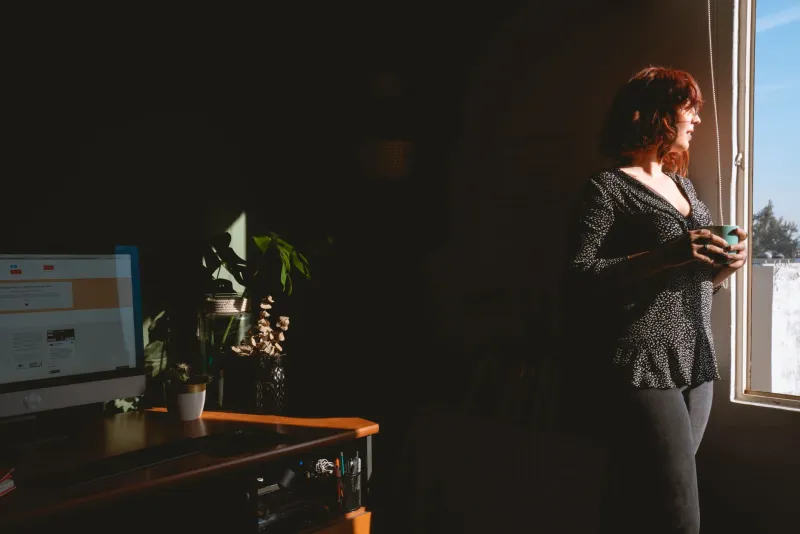
The Talk You Keep Putting Off Is Probably About One Specific Thing

You've rehearsed it in the shower. You've drafted it in your head during your commute, on a walk, in the middle of the night when you should've been asleep. You've imagined how they'd respond, prepared your counterpoints, talked yourself into doing it — and then, when the moment arrived, you found a reason to let it pass.
Maybe next week. Maybe after the holidays. Maybe when things calm down a little.
If you've been in this loop, you're not alone. Avoidance of difficult conversations is one of the most universal human experiences, and yet it's one of the loneliest-feeling ones. It tends to happen in silence, which makes it easy to believe you're the only one who can't seem to just say the thing.
But here's what's worth exploring: the conversations we avoid most persistently aren't random. They tend to cluster around a specific type of fear — and once you identify yours, the pattern gets a lot harder to ignore.
What Avoidance Actually Sounds Like
It rarely announces itself as fear. Instead, it comes dressed as practicality. "Now isn't the right time." "They're already stressed." "It's probably not that big a deal." "I don't want to make things weird."
These sound like reasonable considerations, and sometimes they genuinely are. But when the same justifications cycle through your head every time a particular topic surfaces — with a particular person, or a particular type of relationship — that's not strategic timing. That's avoidance with a good PR team.
The conversations people tend to postpone longest fall into a few recognizable categories: asking for what you actually need, setting a boundary you've let slide for too long, addressing a rift that's been quietly festering, or telling someone a truth that might change how they see you. What these have in common is that they all require you to put something real on the line.
The One Thing Most Avoided Conversations Are Really About
If you trace most of these postponed conversations back to their root, they tend to land in the same place: a fear of being seen clearly and rejected anyway.
Not just rejected — specifically, rejected after being honest. That's the particular dread. Because as long as you haven't said the thing, you can tell yourself the relationship is intact, the situation is manageable, the other person doesn't really know how you feel. The moment you say it out loud, that buffer disappears.
This plays out in romantic relationships when someone can't bring themselves to say they're unhappy, because saying it makes it real and then something has to change. It shows up at work when an employee won't tell their manager what they actually need, because asking feels like admitting weakness. It happens in families where old dynamics have calcified into roles nobody chose and nobody's willing to challenge, because challenging them risks the whole structure.
The content of the conversation matters less than you think. What makes it hard isn't the topic — it's the vulnerability it requires.
Why We'd Rather Let Things Fester
There's a particular kind of discomfort that comes with an unresolved conversation — a low-grade tension that hums in the background of your interactions with that person. You know it. They might sense it too, even if neither of you names it.
And yet, for a lot of people, that chronic low-grade discomfort feels safer than the acute discomfort of actually having the conversation. Chronic is familiar. Acute is unpredictable.
This is partly about how our brains handle uncertainty. We're wired to fear unknown outcomes more than known bad ones, which sounds irrational until you remember that the brain's primary job is threat management, not happiness optimization. An unresolved conversation is uncomfortable but survivable. A conversation that goes badly? That's a threat the brain hasn't modeled yet — and that unknown outcome can feel more dangerous than it probably is.
The result is that we end up choosing the slow burn over the possible fire, even when the slow burn is doing its own kind of damage.
Recognizing Avoidance as Information
Here's a reframe that might be useful: the intensity of your avoidance is proportional to how much the relationship or situation matters to you. You don't spend weeks dreading conversations with people you don't care about. The dread is actually a signal of investment.
Which means if you've been avoiding a particular talk for a long time, that's worth noticing. Not as a reason to feel guilty about the delay — guilt is rarely productive here — but as useful information about what you actually value and what you're afraid of losing.
Ask yourself: if I knew for certain this conversation would go fine, would I have it tomorrow? If the answer is yes, then the obstacle isn't the topic. It's the uncertainty about the outcome. And that's a much more workable problem.
Actually Breaking the Cycle
Starting is almost always the hardest part, so make the bar for starting as low as possible. You don't need to have the perfect opening line. You don't need to have thought through every possible response. You just need to say something that signals you want to talk — and then the conversation takes over from there.
"I've been wanting to bring something up with you" is a complete sentence. So is "Can we talk about something that's been on my mind?" These aren't dramatic declarations. They're just doors.
It also helps to separate the conversation from its imagined worst-case outcome. Most avoided conversations don't end relationships — they clarify them. The talk you've been dreading about money with your partner, or the boundary you need to set with a friend, or the feedback you need to give a coworker — these are far more likely to shift something in a workable direction than to blow everything up. Not always. But usually.
And in the cases where the conversation does reveal something difficult? That's information you needed. Living with the unspoken version wasn't protecting the relationship — it was just postponing the reckoning.
The Thing About Waiting for the Right Time
The right time for a hard conversation is almost never going to announce itself. There won't be a perfect window where everything feels calm and both people are fully ready and the stakes feel manageable. That window is largely a myth.
What there will be is a moment where you decide the cost of staying silent is higher than the discomfort of speaking. That's not a moment you stumble into — it's one you choose. And it turns out that's the only thing that was ever standing between you and the conversation you've been rehearsing for months.